競賽介紹

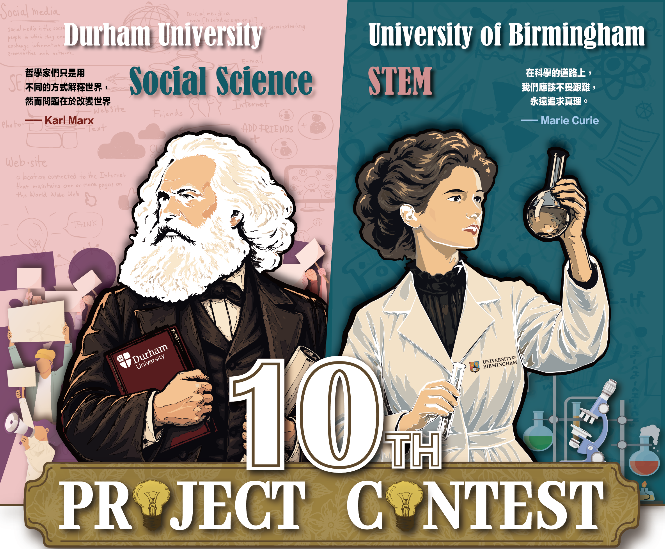
第十屆英國大學專題競賽正式開跑!每一年的英國大學專題競賽激發了學生的創新思維與跨領域才華,表現優異者不僅能榮獲豐厚獎學金,更能取得直通英國頂尖學府的入學機會。

本屆賽事將由享譽全球的世界百大杜倫大學Durham University與伯明翰大學University of Birmingham在臺攜手合辦,期待更多臺灣學生在世界級舞台上大放異彩!

競賽主題

專題競賽分為 Social Science 組與 STEM 組兩大項目:Social Science 組由 Durham 大學主辦,STEM 組由 Birmingham 大學主辦。學生可依自身興趣與專長,自由選擇任一項目進行專題計畫,發揮所長!

​競賽題目

Business – Strategy and Future Trends Challenge

Task:

Businesses around the world are facing unprecedented technological, economic, environmental, and social changes. As a team of business consultants, your task is to investigate a contemporary or emerging business challenge, analyse its implications for organisations, evaluate possible strategic responses, and propose well justified recommendations, supported by research and business theory.

You will present your research and recommendations in a format of your choice, such as a PowerPoint presentation, business report or academic poster.

Steps to Help You Complete This Task

1. Choose a Business Challenge

Select one significant business issue (from the list given below) affecting organisations today or likely to impact businesses in the future.

2. Research the Issue

Consider:

  • Why is this issue important?
  • Which industries or businesses are most affected?
  • What does current research, market data, or industry evidence show?
  • What strategies are businesses currently using to address this challenge?
  • What future trends may influence the issue?

3. Develop Strategic Options

  • Propose at least two possible business strategies.
  • Analyse the advantages and disadvantages of each option.
  • Consider financial, operational, ethical, and strategic implications.

4. Recommend Your Strategy

Choose the strategy you believe is most effective.

Explain:

  • Why it is the best option
  • How it supports long-term business success
  • Potential risks and how they could be managed
  • The expected impact on stakeholders

★★★ Ensure that all sources used are properly referenced. ★★★

Use reliable business sources such as:

  • Statista
  • World Economic Forum
  • Financial Times
  • Harvard Business Review

Suggested Presentation Structure

Introduction

  • Introduce the business challenge.
  • Explain why it matters to organisations today.

Evidence

  • Present key research, statistics, and industry trends.
  • Explain who is affected and why.

Strategic Options

  • Describe at least two possible solutions.

Evaluation

  • Compare the strengths and weaknesses of each option.
  • Apply relevant business frameworks where appropriate:
    • SWOT Analysis
    • PESTLE Analysis
    • Porter’s Five Forces
    • Ansoff Matrix

Recommendation

  • Present and justify your preferred strategy.

Conclusion

  • Summarise your findings.
  • Leave the audience with a clear final message.

Suggested Business Scenarios (Choose One)

Current Business Challenges

  • The impact of Artificial Intelligence on business operations and employment
  • Managing global supply chain disruptions
  • Rising inflation and changing consumer spending habits
  • Cybersecurity threats and business resilience
  • Sustainability and achieving net-zero business operations
  • The impact of geopolitical conflicts on international business
  • ESG (Environmental, Social, and Governance) and corporate performance

Future Business Challenges

  • The future of AI-driven businesses by 2035
  • The role of automation and robotics in the workplace
  • The future of electric vehicles and sustainable transport
  • The circular economy and waste-free business models
  • Climate change adaptation and business survival

Your group must produce a professional presentation that:

  1. Clearly explains the chosen business challenge.
  2. Uses evidence and research to support analysis.
  3. Evaluates at least two strategic options.
  4. Recommends one realistic and well-justified solution.
  5. Demonstrates the application of business concepts and frameworks.

~ Good luck and think like business leaders preparing organisations for the future. ~

Engineering Against Natural Disasters
STEM Project Contest – Competition Brief

1. Introduction

Natural disasters such as earthquakes, volcanic eruptions, typhoons, floods and landslides can have a major impact on people and communities. They can damage homes, schools, roads and essential services, and can make it difficult for communities to access food, water, electricity or medical support.

Engineers play an important role in helping communities prepare for, withstand and recover from these challenges. They design stronger buildings, safer infrastructure, flood protection, early-warning technologies and many other solutions that can reduce damage and protect lives.

This project challenges students to think like engineers and develop an innovative solution to a real-world natural disaster problem.

2. Competition Challenge

Imagine that you are an engineer. Choose ONE natural disaster and design an engineering solution that could help protect people, infrastructure or essential services from its effects.

Your solution should address a clearly defined problem faced by a specific community or group of people. You should explain how your solution works, why it could be useful, and whether it could realistically be implemented.

You may choose:

  • Earthquakes
  • Volcanic eruptions
  • Typhoons
  • Floods
  • Landslides
  • Extreme heat
  • Drought or water shortages
  • Another natural disaster, provided you clearly explain your choice

Your solution could be:

A building, structure, product, device, technology, transport system, energy system, communication system, water system, piece of infrastructure or another engineering concept.

3. Project Requirements

To ensure that all projects can be assessed fairly, every project should address the following areas:

  • The problem Identify the natural disaster, explain the problem it creates, and describe where and when the problem may occur.
  • The people or community Identify who is affected and who your solution is designed to help. Explain the specific needs of these people or the community.
  • The engineering solution Describe what you have designed and explain how it addresses the problem. Explain what makes your idea innovative or different.
  • How it works Explain the basic scientific, technological and engineering principles behind your solution. Students should demonstrate how their design would operate rather than simply describing what it looks like.
  • Design and visualisation Use drawings, diagrams, digital designs, models, animations or a prototype to communicate the design clearly. A physical prototype is not required.
  • Real-world feasibility Consider whether the solution could actually be built and used. Consider factors such as materials, cost, location, safety, maintenance, environmental impact and access to technology.
  • Impact Explain how the solution could reduce damage, save lives, protect essential services or help communities recover more quickly. Students should also identify any limitations of their solution and possible future improvements.

4. Suggested Presentation Structure

Students may organise their presentation in their own way, but it should clearly cover the following:

  1. Introduction – identify the natural disaster and the problem.
  2. The Community – explain who is affected and who the solution is designed for.
  3. The Engineering Challenge – explain what needs to be solved.
  4. Your Solution – describe the proposed engineering design.
  5. How It Works – explain the relevant science, technology and engineering.
  6. Design – show drawings, diagrams, models, digital designs or prototypes.
  7. Feasibility – consider materials, cost, location, safety and practical implementation.
  8. Impact – explain how the solution would help people or communities.
  9. Limitations and Future Improvements – identify weaknesses and how the design could be developed further.
  10. Conclusion – summarise why the proposed solution is an effective response.

5. What We Are Looking For

The strongest projects will demonstrate:

  • A clear understanding of the natural disaster and the problem being addressed.
  • Evidence of engineering thinking and an explanation of how the proposed solution works.
  • Creativity, originality and innovation.
  • Practical thinking and consideration of real-world constraints.
  • Consideration of the people and communities who would benefit.
  • Clear, engaging and well-structured communication.
  • Effective use of visual material to explain the design.

Students do not need advanced engineering knowledge. The competition is intended to encourage students to identify a real-world problem, think creatively and use engineering ideas to develop a possible solution.

6. Important Guidance

  • Students may work individually or in teams of up to three members.
  • The project should be the students’ own work. Teachers or other adults may provide guidance and support but should not produce the project for the students.
  • Students should acknowledge information, images, data or other material taken from external sources.
  • Students should consider copyright and intellectual property when using photographs, video, music, graphics or other third-party material.
  • Students are not expected to build a fully working product. A clear and well-explained concept, supported by appropriate visual material, is sufficient.
  • There is no single correct engineering solution. Judges will assess how effectively students understand the problem and apply engineering thinking to their proposed solution.

7. Example Areas for Inspiration

Students may develop their own ideas. The following examples are intended only to illustrate the range of possible engineering approaches:

  • An earthquake-resistant house or school.
  • A flood-protection system for homes or public buildings.
  • A smart warning device for floods or landslides, or even volcanic eruptions.
  • Stronger windows, roofs or structures for areas affected by typhoons.
  • An emergency communication system that works when mobile networks fail.
  • Drones or robots to support rescue teams after a disaster.
  • A temporary shelter for people who have lost their homes.
  • A system that provides clean water or electricity after a disaster.
  • A cooling or shading system to protect communities during extreme heat.
  • A low-cost engineering solution designed specifically for communities with limited resources.

8. Final Advice to Students

Think like an engineer: identify a real problem, understand the people affected, develop a solution, explain the science and engineering behind it, and consider whether it could work in the real world.

The judges are not looking for the most complicated idea. They are looking for a clear problem, thoughtful engineering, creativity and a convincing explanation of how the proposed solution could make a difference.

~ Wishing students all the best of luck from University of Birmingham! ~

競賽相關規定與辦法

報名組別與序號

報名截止日期為 2026/12/30 (三) 下午01:00前;

完成報名後,系統將於五天內(不含假日)發送 Email 通知確認報名成功,並一併告知參賽組別代號。

作品繳交與注意事項

初賽參賽影片注意事項

  • 影片長度8-11分鐘,不得低於8分鐘或超過11分鐘


  • 參賽者(任一)須出現於影片時間至少2/3以上


  • 若有引用其他影片,請務必確認智慧財產權相關使用規範,若有盜用非授權影片之情事,將取消參賽資格


  • 初賽影片繳交截止日為 2027/02/23 (二) 下午 1:00 前

    超過1小時以內扣5分、2小時以內扣10分、3小時以內扣20分、4小時以內扣40分,
    超過2027/02/23 (二) 18:00 止恕不受理。


  • Email主旨與影片規範注意事項,不符合相關規定之隊伍,評審將斟酌扣分


  • 參賽作品連結完成上述規範後,寄至 info@isc-edu.com,即完成初賽作品繳交。協辦單位收到後會在五個工作天內,以mail回覆確認收到參賽作品;若未收到回覆,請主動來電告知以利查詢;未繳交作品之組別本中心將不另行通知,請務必確認報名程序完整。

    請參賽隊伍務必將影片確定設定為公開,以利國外評審觀看評分。


  • 上傳 Youtube 影片之標題需符合以下格式並設定公開

參賽組別Durham 組Birmingham 組
參賽主題Social ScienceSTEM
Youtube影片標題10TH Social Science Project Team oo ( xx 高中 )10TH STEM Project Team oo ( xx 高中 )

( oo為組別代號、xx為所屬高中名字)

  • 繳交作品E-Mail 主旨:

參賽組別Durham 組Birmingham 組
參賽主題Social ScienceSTEM
 E-mail 主旨10TH Social Science Project Team oo ( xx 高中 )10TH STEM Project Team oo ( xx 高中 )

( oo為組別代號、xx為所屬高中名字)

決賽參賽PPT注意事項

  • 簡報檔案格式僅限 Power Point,請配合轉檔成 PPT 格式


  • 若有引用其他參考文獻,請務必確認智慧財產權相關使用規範,若有盜用非授權之情事,將取消參賽資格


  • 簡報檔繳交截止日為 2027/04/02 (五) 下午 01:00 前

    超過1小時以內扣5分、2小時以內扣10分、3小時以內扣20分、4小時以內扣40分,超過2027/04/02 (五) 18:00 止恕不受理。


  • Email 主旨與 PPT 簡報規範注意事項,不符合相關規定之隊伍,評審將斟酌扣分


  • 決賽PPT 完成上述規範後,寄至 info@isc-edu.com,即完成決賽作品繳交。

    協辦單位收到後,將於五個工作天內,以mail回覆確認收到參賽作品。


  • PPT簡報檔案名稱:

參賽組別Durham 組Birmingham 組
參賽主題Social ScienceSTEM
PPT檔案名稱10TH Social Science Project Final Team oo ( xx 高中 )10TH STEM Project Final Team oo ( xx 高中 )

( oo為組別代號、xx為所屬高中名字)

  • 繳交作品 E-Mail 主旨:

參賽組別Durham 組Birmingham 組
參賽主題Social ScienceSTEM
E-mail 主旨10TH Social Science Project Final Team oo ( xx 高中 )10TH STEM Project Final Team oo ( xx 高中 )

( oo為組別代號、xx為所屬高中名字)

競賽條例

• 作品必須由學生自行製作,指導老師僅作輔導協助

• 所有參賽作品恕不退還,作品版權(PPT&影片)歸主辦單位擁有,入選作品將發布於 www.isc-edu.com 網站上與 youtube 上

• 參賽作品如涉及抄襲、著作版權侵犯或違法行為,經查證屬實,於接受作品或評審期間將不予受理;而於得獎後發現者,將撤銷其隊伍的參賽資格並收回已頒發之獎座、獎狀等獎項。參賽隊伍須對一切法律責任自行負責,與本主辦單位無關

• 參賽者在遞交作品後,即表示同意上述所有條款規則,並無保留下解除任何與主辦機構因刊登其作品任何法律責任及同意賠償所有違章而引起主辦單位的損失。不遵守本章則之參賽者將會被取消參賽資格

• 進入決賽隊伍,需於時間內繳交檔;決賽當天使用 PPT 現場進行簡報,檔案無法修改,將由英國大學代表評選優勝隊伍

評分標準

15%Understanding of the Business Challenge
20%Research and Evidence
15%Analysis of the Issue
10%Strategic Options
15%Evaluation of Strategic Options
10%Application of Business Theory and Frameworks
10%Recommendation and Justification
5%Professionalism and Presentation Quality
20%Understanding of the problem
20%Engineering knowledge and solution
20%Creativity and innovation
20%Practicality and feasibility
20%Presentation and communication
  • 初賽除上述評分標準,影片規範需符合競賽規則,無符合規定者將予以扣分
  • 決賽除上述評分標準,PPT 規範需符合競賽規則,並且不可看手稿或是 ipad …等設備逐字看稿朗讀,評審方可視情況予以扣分計算,無符合參賽規定者將予以扣分
  • 決賽 PPT 於截止時間後要求修改,為求比賽公平性修改 PPT 將予以扣分,逾期則示為放棄比賽

獎勵辦法

• 有繳交作品並符合作品規範之參賽隊伍,每名參賽同學獲得參賽證一張

• STEM 組與 Social Science 組將各取前10名,獲得獎狀一只; 第 1-5 名於決賽當天現場領取 (請注意:領取獎狀者不另寄發參賽證)

• 所有參賽者務必於報名完成時確認清楚英文拼音,參賽證&獎狀發放後非主辦方錯誤將不予修改補寄

• 參賽證&獎狀統一寄送至學校,由學校老師代為發放;寄出後將以Mail通知各參賽者領取方式,請所有繳交作品的參賽隊伍自行確認Mail

名次預科獎學金或禮品卷其他
第一名Durham 或 Birmingham Foundation Program 預科學費 GBP 7,000 獎學金(每名)或 GBP 1,050等值禮品卷(整組)獎狀(每名)與獎盃(整組)一只
第二名Durham 或 Birmingham Foundation Program 預科學費 GBP 5,000 獎學金(每名)或 GBP 600等值禮品卷(整組)獎狀(每名)
第三名Durham 或 Birmingham Foundation Program 預科學費 GBP 4,000 獎學金(每名)或 GBP 300等值禮品卷(整組)獎狀(每名)
第四名Durham 或 Birmingham Foundation Program 預科學費 GBP 3,000 獎學金(每名)/獎狀(每名)
第五名Durham 或 Birmingham Foundation Program 預科學費 GBP 3,000 獎學金(每名)/獎狀(每名)

第六名

至

第十名

Durham 或 Birmingham Foundation Program 預科學費 GBP 2,000 獎學金(每名)/獎狀(每名)
  • 預科獎學金以主辦單位 Durham University International Study Centre 或 Birmingham International Academy 之預科課程學費折抵為限。入學就讀之相關申請作業與相關標準,另須遵守兩校之相關程序與規定,以最新公告為主,大學保留審核與異動之權利。

  • 獎學金係針對前往杜倫大學和伯明翰大學就讀之學生發放,獎學金至多保留一年。且須於協辦單位規定之期限內繳交相關文件以保留資格,並於取得國外大學錄取offer後,依期限內繳交GBP 1,260訂金保留獎學金。

  • 前三名隊伍,每名組員可分別決定要選擇獎學金或禮卷。禮卷金額為總數除以報名人數,各別給予。
    例如:A組共3人報名比賽獲得第一名,其中兩名選擇獎學金,另外一名選擇禮卷,則A組兩名成員可各別拿到半額獎學金,另外一名組員為1050除以3,獲得350英鎊等值禮卷。

  • 僅第一名至第三名提供禮品券之選擇,其餘名次無禮品券之選項。

比賽日程

階段日期與時間詳情
報名截止2026/12/30 (三) 13:00 前報名截止
初賽影片繳件截止2027/02/23 (二) 13:00 前影片作品連結繳交至info@isc-edu.com
公佈各組初賽結果2027/03/16 (二) 15:00公佈各組初賽成績
入圍隊伍 PPT 繳件截止2027/04/02 (五) 13:00 前PPT作品繳交至info@isc-edu.com
台北決賽2027/04/17 (六) 09:00-17:00

報名專題競賽三步驟

1. 下載參賽同意書並親簽

2. 線上填寫google表單並上傳同意書​

3. 報名後確認郵件有收到回覆,即完成報名